Is webforJ production ready? What's behind the name

You are about to pick a UI framework for an app that has to run for ten years, and the name webforJ is one you only heard recently. Asking "is webforJ production ready" is the right question. Here are the published facts. webforJ, the full-stack Java framework, is a Java API built by BASIS International, on top of BBj and the Dynamic Web Client (DWC), shipped through Maven Central with regular numbered releases and Spring Boot integration.
This post takes the doubts one at a time, myth by myth.
Already running Spring Boot?
Ask the team how webforJ fits into your existing Spring app.
Myth: webforJ is brand new
Fact: the name is recent, the technology is not. webforJ is a Java API around the DWC, the browser client that BBj has shipped to developers. BBj is the foundation: every webforJ component we ship maps one to one to an underlying BBj control, as our architecture documentation shows. You build on that foundation entirely in Java.
That mapping is the point. When you place a Button or a Table on a page, you are not trusting a UI toolkit that was written last year. You are driving components that sit on a client and a server runtime from BASIS. The webforJ layer is the part that is new, and it is the part you can read, test and upgrade like any other Java library.
Who is behind webforJ
webforJ is built by BASIS International. BASIS software and software tools have been used to develop business solutions for both large international corporations and SMEs for almost 40 years, with 20+ years of delivering technology built on Java.
Operating its own sites in North America and Europe and working with partners in more than 30 countries, BASIS is well positioned on the international stage.
For a procurement conversation, these sentences answer "is there a company behind it." The wider case is made in what sets webforJ apart and why we built it.
Myth: a new framework has no lineage
Fact: the lineage runs in a straight line. BASIS created the newest version of BBx®, the sixth generation, using Java technology. webforJ is a Java API around the BBj language's DWC.
webforJ 26.00 requires Java 21 or later, and Java 25 is also supported.
Is webforJ production ready?
Production readiness is about what happens after the first release, so look at the cadence. These are the webforJ versions published from April 2024 onward.
| Year | Versions |
|---|---|
| 2024 | 24.00, 24.01, 24.02, 24.10, 24.11, 24.12, 24.20 |
| 2025 | 24.21, 24.22, 25.00, 25.01, 25.02, 25.03, 25.10 |
| 2026 | 25.11, 25.12, 26.00, 26.01, 26.02 |
Version 24.00 went live on April 8, 2024, and 26.02 followed on August 31, 2026. The major number moves about once a year, with feature releases in between. Each webforJ version has a BBj version with the same number.
The upgrade path is also tooling, not a rewrite. Version 26.00 introduced webforj-rewrite, a set of OpenRewrite recipes that move a project to the new major. Spring Boot support moved with it, to Spring Boot 4.x. You can read the details in the Spring Boot integration guide.
Distribution is ordinary Java distribution. The artifacts are on Maven Central, so the dependency lands in your build the same way every other library does.
Myth: nobody runs it in production
Fact: customers have published their results. Our success stories page lists Prodin, Audev's CarIT and more.
Prodin is a good one to read, and the Prodin success story is a short PDF. Within four months, Prodin delivered their first web-based modules to customers. Prodin assembled a six-member Java development team, including junior and mid-level developers, to assist in the migration.
Myth: it will not fit our Java stack
Fact: webforJ is a Java framework, and it works with the tools a Java team already uses. You build with Maven, you run on Java 21 or later, and you can add Spring Boot so that services and repositories are injected into your UI classes through the constructor. Your build, your CI and your code review process stay the same.
The browser side is covered by the DWC, so for standard components there is no second codebase in JavaScript to staff and maintain. Fewer moving parts means fewer things to keep current.
The enterprise checklist
Teams looking for a Java web framework for enterprise use usually check the same things. This is how webforJ answers them with published facts. For the wider field, see the best Java UI framework for business apps.
| Question | Answer |
|---|---|
| Who builds it | BASIS International |
| Where are they | Operating its own sites in North America and Europe |
| Java experience | "20+ years of delivering technology built on Java" |
| How is it released | Numbered releases shared with BBj, from 24.00 in April 2024 to 26.02 in August 2026 |
| How is it distributed | Maven Central |
| Does it fit Spring | Yes, with Spring Boot integration |
That is a full-stack Java framework from BASIS International, built on BBj and the DWC.
Try it on your own code
The quickest way to settle the question is to generate a project and judge it. startforJ builds a Maven project in a minute, and the getting started guide walks through the first run. Pick one screen from your current app and build it. Production readiness shows up fast when it is your own data and your own build.
Frequently asked questions
Is webforJ production ready?
webforJ has been released on a regular schedule since 24.00 in April 2024, and 26.02 shipped in August 2026. It sits on BBj and the DWC from BASIS International, and our success stories page lists Prodin, Audev's CarIT and more.
Who is behind webforJ?
BASIS International. BASIS software and software tools have been used to develop business solutions for both large international corporations and SMEs for almost 40 years, with 20+ years of delivering technology built on Java. Operating its own sites in North America and Europe and working with partners in more than 30 countries, BASIS is well positioned on the international stage.
Does webforJ keep up with new Java versions?
webforJ is built on BBj and the DWC from BASIS International, with a visible release record. Version 26.00 requires Java 21 or later and also supports Java 25. Upgrades between majors come with OpenRewrite recipes.
Does webforJ work with Spring Boot?
Yes. You can generate a Spring Boot webforJ project with startforJ or Maven archetypes and inject Spring-managed beans into your UI components. The Spring Boot guide shows the setup.
Bouw je iets met webforJ?
Bespreek je project, migratie of de geschiktheid van webforJ met het team.
Verder lezen
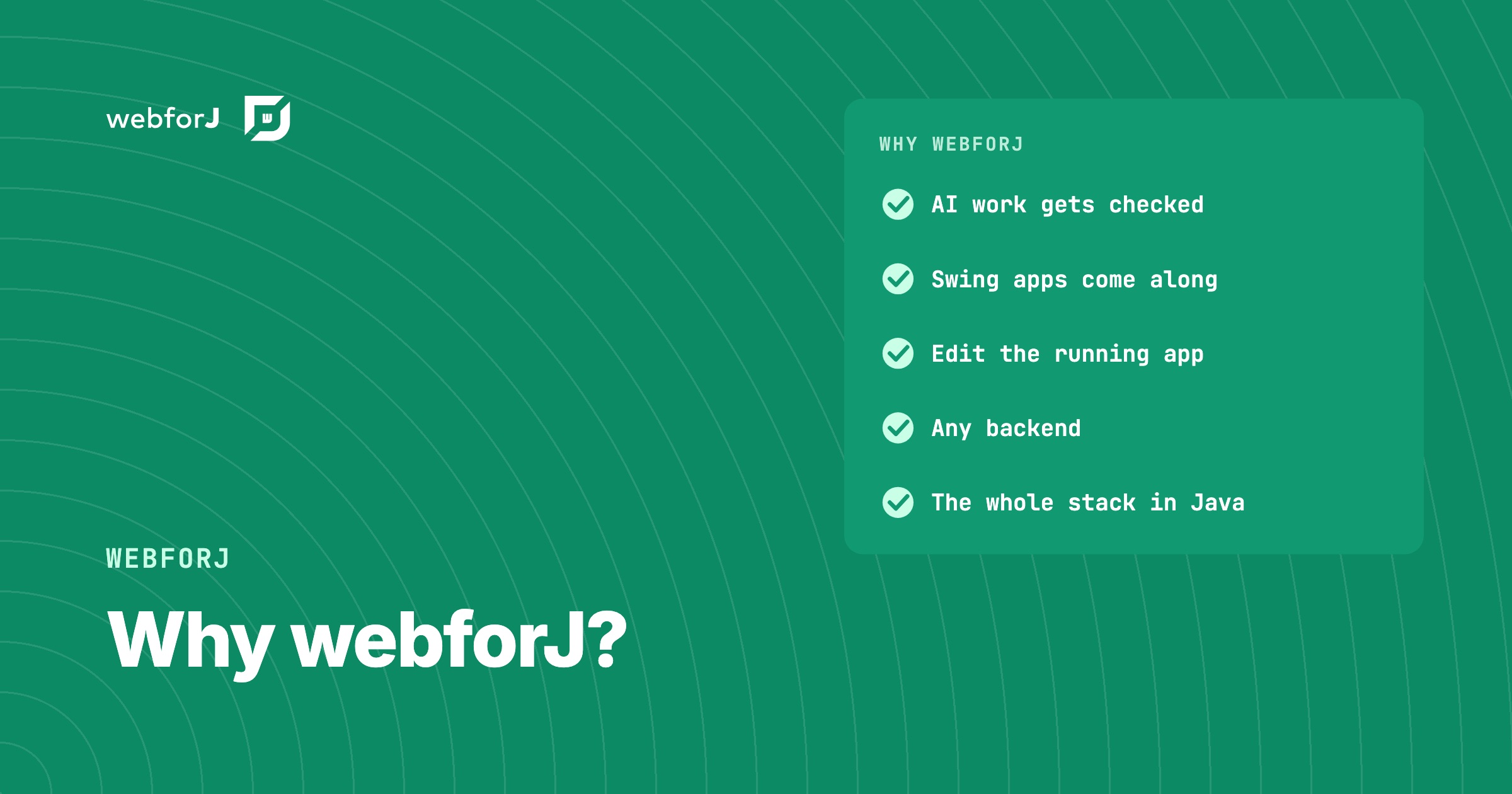 Why webforJ? Straight Answers to Questions Java Teams AskWhy webforJ for your next business web app? What sets it apart, why we built it, who stands behind it, and how it fits your backend and your own components.
 The best Java UI framework for enterprise business apps in 2026How to pick the best Java UI framework for enterprise and internal business apps in 2026: Thymeleaf, Jakarta Faces, a JavaScript SPA, or webforJ, with working code for the Java-only route.
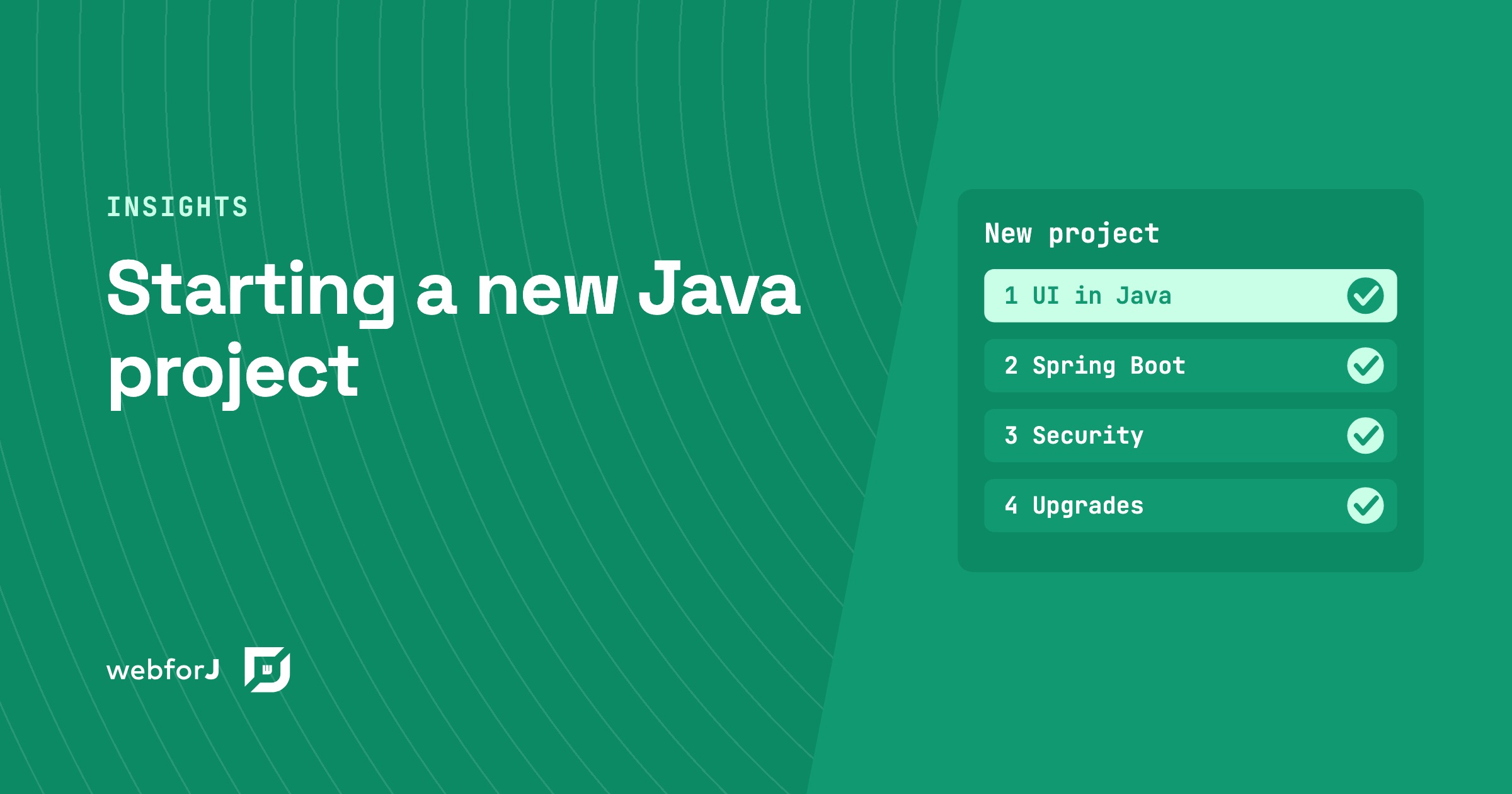 Starting a New Java Project: The Decisions That Shape the StackStarting a new Java project for a business web app? The decisions a team settles first, from UI and backend to security, testing, AI and upgrades.