Saltar al contenido principal

32 publicaciones etiquetados con "Modernization"

Modernizing legacy Java apps.

Ver todas las etiquetas

Legacy Java application modernization strategy for enterprises

· 10 min de lectura
webforJ
Do it all in Java. The full-stack Java framework for business web apps.

cover image

Most large Java shops do not have one aging app. They have a portfolio: a Swing client in finance, JSP pages in operations, a JSF module nobody wants to change, and a Struts app that three people understand. Each one has its own budget fight, and the instinct is to give each its own plan.

The legacy Java app modernization strategy that holds up is simpler. Triage every app by business value and technical risk, keep the services and data that already work, and move the screens to one target: webforJ, the full-stack Java framework. One framework for the whole portfolio can mean one skill set, one security model and one hiring profile, whether the starting point was Swing, JSP, JSF, or Struts.
Eclipse RAP alternative: move SWT screens to webforJ

· 10 min de lectura
webforJ
Do it all in Java. The full-stack Java framework for business web apps.

cover image

Your team has a business app that runs in the browser through Eclipse RAP. The screens are written with the SWT and JFace API, the developers who built it know Java well, and now someone is asking what comes next. If you are weighing an Eclipse RAP alternative, webforJ, the full-stack Java framework, is the one that keeps your team in Java: screens are Java objects with listeners, they render as modern web components, and the whole app can plug into your Spring Boot services.

This guide helps you decide whether to stay or move, maps the concepts you already know to their webforJ counterparts, and lays out a plan to migrate an Eclipse RAP app one screen at a time.

Apache Wicket alternative: component based, no templates

· 7 min de lectura
webforJ
Do it all in Java. The full-stack Java framework for business web apps.

cover image

If your team has built with Apache Wicket, you already like the idea that a page is a tree of Java components and that the server owns the state. What you may want to change is keeping every Java class paired with an HTML file next to it. webforJ, the full-stack Java framework, is an Apache Wicket alternative that keeps the component tree and the server side Java, and removes the markup files: the whole screen is Java, with modern web components, annotation based routing, Spring Boot integration and data binding.

This post covers what carries over from Wicket, what disappears, and how to move one screen at a time.

Migrate a Java desktop app to the web with AI: a decision guide

· 8 min de lectura
webforJ
Do it all in Java. The full-stack Java framework for business web apps.

cover image

Asking an AI assistant to convert a whole Swing app in one pass sounds fast. In practice you get thousands of lines nobody has reviewed, written against APIs the model half remembers, and a release date that keeps slipping.

There is a better way to migrate a Java desktop app to the web with AI: move it one screen at a time. Some screens are worth rebuilding in webforJ with an assistant connected to the webforJ MCP server. Others keep running as they are, embedded in the web app through WebswingConnector, until their turn comes. Your business logic stays in Java, and users get a web app from the first release.

JavaFX vs Swing: which Java GUI framework to pick in 2026

· 9 min de lectura
Hyyan Abo Fakher
Lead Software Architect

cover image

If you want to keep writing Java and you are picking a Java GUI framework today, webforJ is the option that gets you a browser-delivered UI without leaving the language. You build screens from Java classes, run them on the server, and users open a URL. Swing and JavaFX remain the choice when the app must work offline. If offline isn't a requirement, a webforJ app can be installed too, so it sits on the desktop, home screen or app menu like a native app.

The decision is mostly about delivery. Swing and JavaFX put the UI on each user's machine. A web UI written in Java puts it on one server and shows it in a browser. This post compares the three on the questions that change the outcome, then shows what the same button handler looks like in Swing and in webforJ.

GWT to Spring Boot migration: move your UI to webforJ

· 9 min de lectura
webforJ
Do it all in Java. The full-stack Java framework for business web apps.

cover image

Many GWT teams want to keep writing their UI in Java but no longer want a Java-to-JavaScript compile step in the middle. For a GWT to Spring Boot migration, webforJ is a full-stack Java framework and a GWT alternative built for that. You build screens from Java components, they run on the server next to your Spring Boot services, and the browser renders them. There is no client-side code to compile and no RPC layer between the UI and your services.

This post compares the two models, maps GWT concepts to their webforJ counterparts, and shows how a team can move an existing GWT app one screen at a time.

Swing modernization for enterprises: a decision guide

· 8 min de lectura
webforJ
Do it all in Java. The full-stack Java framework for business web apps.

cover image

Somewhere in your portfolio there is a Java desktop app that people depend on every day. It carries years of business rules, nobody wants to change it, and the requests to put it in a browser keep coming. Swing modernization for enterprises is the work of moving that app to the web without stopping the business that runs on it. Our recommendation is a three-phase path: run the existing app in the browser now with Webswing, rebuild screens in webforJ, the full-stack Java framework, in order of business priority, then retire the desktop client. Your Java team and your business logic stay in place the whole way.

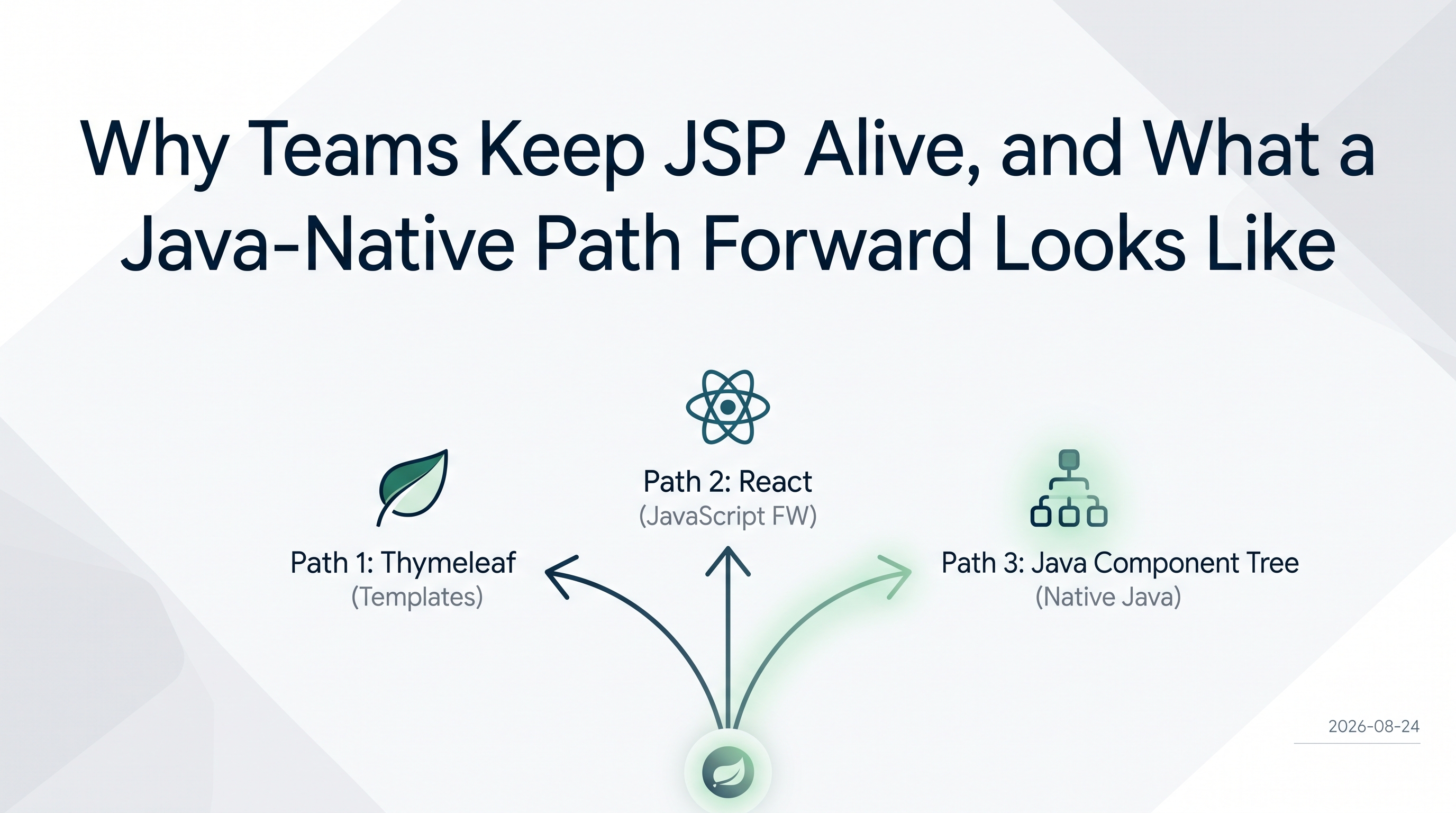
Why Teams Keep JSP Alive, and What a Java-Native Path Forward Looks Like

· 11 min de lectura
webforJ
Do it all in Java. The full-stack Java framework for business web apps.

cover

The customers.jsp has been in production since 2011. The team knows every quirk: the pageContext.getAttribute calls that pull in the session-managed customer list, the JSTL loop that renders the rows, the shared header partial included from /WEB-INF/includes/header.jsp. It works. Operations knows how to deploy a WAR. The business rules are encoded in the tag libraries. On Monday, leadership asked for a modernization plan.

The SERP for "jsp modernization" gives you two answers: swap the template engine for Thymeleaf, or rebuild the frontend in React. Both are legitimate paths. Neither removes the template layer.

This post covers the third option: replace the JSP page with a Java component tree. Views become Java classes. The loop disappears from the source. The taglib becomes a plain Java class. The include becomes a constructor call. This is not a new idea: it is just underrepresented in the search results because most teams that have done it have not written it down.

Java Swing to web migration: pick the right path

· 10 min de lectura
webforJ
Do it all in Java. The full-stack Java framework for business web apps.

cover image

Your Swing app still works. Users depend on it, the business rules inside it took years to get right, and now someone wants it in the browser. That is where a Java Swing to web migration starts, and most answers you find online begin with a new JavaScript front end.

To migrate a Java Swing app to web, you have three real paths and one combination: rewrite the UI in JavaScript against a new REST API, run the existing app in the browser with Webswing, or rebuild the UI screen by screen in Java with webforJ, the full-stack Java framework. For many Java teams the best long-term target is webforJ, because your developers stay in Java and your business logic carries over. The fastest route to a first browser release is often both together, Webswing first and webforJ second.

Azul 2026 State of Java Survey & Report: Where webforJ Fits

· 4 min de lectura
Ben Brennan
Technical Writer

cover image

Earlier this year, Azul, a Java-focused company, released its 2026 State of Java Survey & Report. Based on responses from over 2,000 Java professionals worldwide, Azul revealed that developers are focused on managing cloud computing, securing apps, and controlling AI output.

Java remains a dominant force in development, with 64% of respondents reporting that more than half of their apps or workloads are built with Java or run on a Java Virtual Machine (JVM). For developers who wish to bring their apps to the browser with minimal changes to their architecture, webforJ, a full-stack Java framework, offers a strategic approach to modernizing apps quickly and efficiently.

JavaFX to web: move your desktop UI to the browser in Java

· 8 min de lectura
Hyyan Abo Fakher
Lead Software Architect

cover image

Your JavaFX app works. Users like it, the domain logic took years to get right, and now someone wants it in a browser: no installer, no JRE on every laptop, access from a phone, or access from a customer site. Rewriting it in JavaScript would throw away the one thing you have plenty of, which is Java.

JavaFX to web does not need a second language. With webforJ, a full-stack Java framework, you keep Java, keep your services and domain classes, and rebuild the screens as routes and components that render in the browser. Screens move one at a time, so the app stays releasable the whole way.

Swing to JavaScript communication with webforJ and Webswing

· 9 min de lectura
Eric Handtke
Software Developer

cover image

Webswing gets a Swing app into a browser tab in an afternoon. Then someone asks for the obvious next thing: when the user picks a customer in the Swing window, the web page around it should show that customer's orders. And the web page can't see anything that happens inside the Swing window.

That is the real problem with Swing to JavaScript communication. The fix is a message channel: the Swing app announces what happened as a named action, the web side reacts, and it can send actions back. In webforJ that channel is one component, and both ends are plain Java.