Siirry pääsisältöön

73 viestiä tägattu "Spring"

Integration with the Spring framework.

Näytä kaikki tagit

Java full stack objections and how webforJ answers them

· 7 minuuttia
webforJ
Do it all in Java. The full-stack Java framework for business web apps.

cover image

Suggest building the whole app in Java and someone on the team will push back. It adds latency, it shuts you out of the JavaScript ecosystem, it won't feel like a real app.

Those are fair questions about full stack Java, where one Java codebase covers the UI, the routing, and the data. With webforJ, the full-stack Java framework, each one has a concrete answer, and a few turn out to be habits you can avoid rather than limits of the model.

Java framework upgrade with OpenRewrite: a webforJ guide

· 5 minuuttia
Matthew Hawkins
Software Developer

cover image

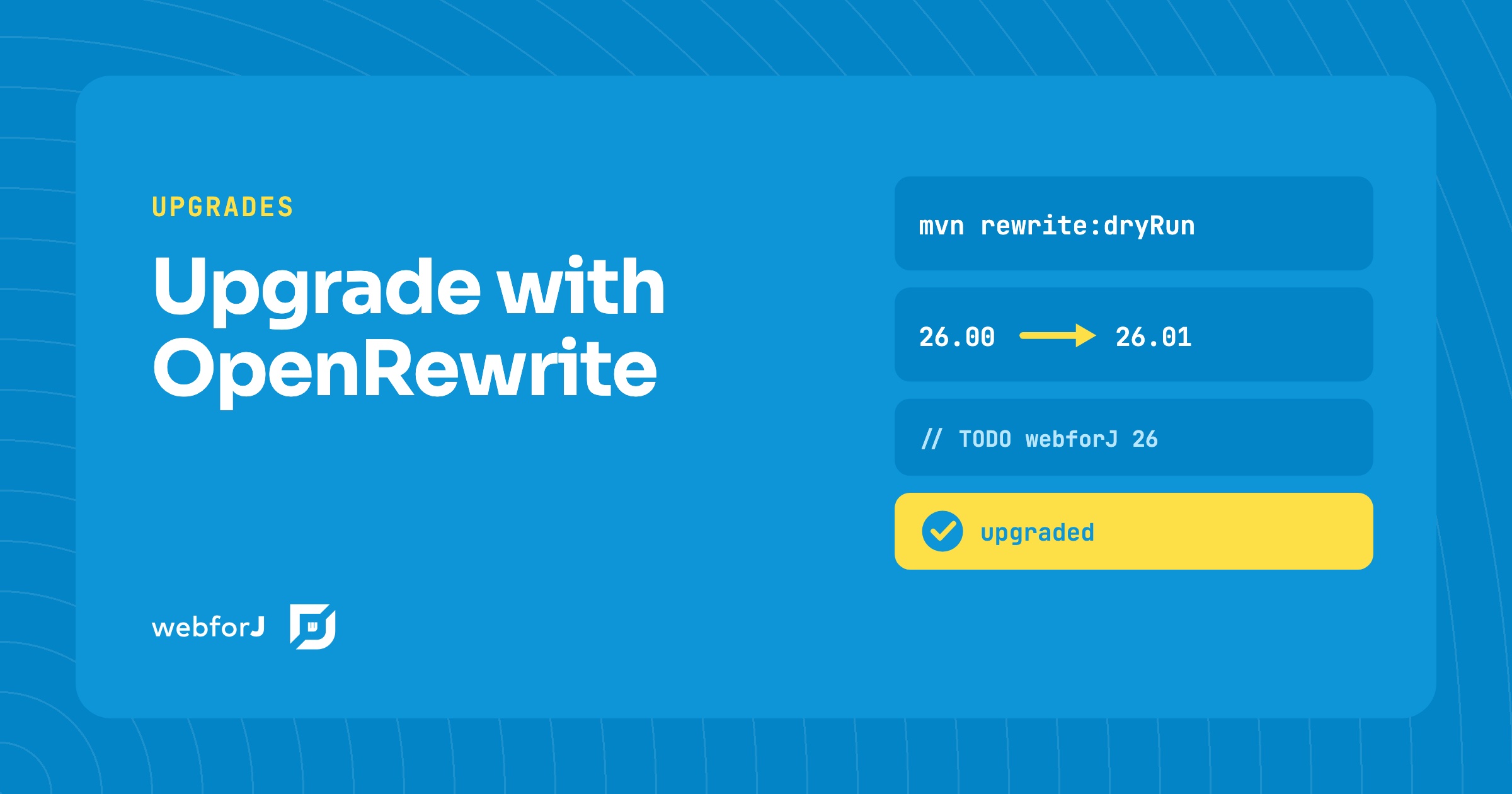
In this tutorial you will upgrade a webforJ app with OpenRewrite. A Java framework upgrade has a reputation for being unpredictable, and a major version can feel like a week of searching through your source tree. For webforJ it doesn't have to be. The webforj-rewrite module ships OpenRewrite recipes for each release, so the mechanical work is automated. You add one Maven plugin, preview the diff, apply the changes, and then clear the TODO comments that remain.

How to build a web app in Java, step by step

· 9 minuuttia
webforJ
Do it all in Java. The full-stack Java framework for business web apps.

cover image

You know Java well, you can write a service in your sleep, and then someone asks for a screen in the browser. Suddenly the advice is to learn a JavaScript framework, a bundler, a templating language and a REST layer between them. You don't need any of that. To build a web app in Java with webforJ, a full-stack Java framework, generate a project with Maven, write each screen as a Java class, and run it with one command. The whole app, UI included, stays in Java.

The best web framework for Java in 2026, by job

· 8 minuuttia
webforJ
Do it all in Java. The full-stack Java framework for business web apps.

cover image

Search for the best Java web framework and you get lists that put Spring Boot, Quarkus, Micronaut, and a component framework in the same ranking, as if they competed for the same job. They don't. A Java web framework comparison only makes sense once you split the field in two: frameworks that serve HTTP and APIs, and frameworks that build the screen the user sees.

Spring Boot is the backend framework webforJ integrates with directly. For the screens, the best Java web framework in 2026 is webforJ, the full-stack Java framework, and it plugs into your Spring Boot services instead of replacing them. You keep your services and write the whole app, screens included, in Java.

Spring AI chat memory: keep chat history per user in webforJ

· 6 minuuttia
Matthew Hawkins
Software Developer

cover image

You ask a chatbot about two plans, then follow up with "and what about the second one?" A good assistant knows what you mean. A forgetful one asks you to start over, because each request reached the model on its own, with nothing from the conversation before it.

Spring AI chat memory fixes that on the server. Spring AI keeps the recent messages for each conversation and adds them to every request, so the model sees the whole thread. In a webforJ app, the one thing left for you to decide is which conversation belongs to which user, and a session-scoped bean handles that in a few lines.

Ollama in a Java Spring Boot UI, built with webforJ

· 7 minuuttia
Matthew Hawkins
Software Developer

cover image

Sending every prompt to a cloud model isn't always an option. Maybe the data can't leave the building, maybe you want to experiment without an API bill, or maybe you just want a chatbot that keeps working when the network doesn't.

Ollama in a Java Spring Boot UI covers all three. Ollama runs the model on your own machine, Spring AI talks to it like any other provider, and a webforJ view shows the chat, so the whole app stays in Java.

Alternatives to htmx for Spring Boot apps

· 9 minuuttia
webforJ
Do it all in Java. The full-stack Java framework for business web apps.

cover image

You have a Spring Boot app, a few server-rendered pages and a growing list of things that should react to the user without a full reload. Someone suggested htmx, and it is a fair suggestion. Then you count what each interaction needs, and the template files and fragment endpoints start to add up.

If you are weighing an htmx alternative for Spring Boot, the short answer is webforJ, the full-stack Java framework. You build each screen as a Java class made of components, handle their events in Java and inject your Spring services into the class. There are no templates and no fragment endpoints to write, so the interactive UI for Spring Boot comes without JavaScript.

Extract data from an image in Java with AI and webforJ

· 8 minuuttia
Eric Handtke
Software Developer

cover image

To extract data from an image in Java, upload the file with the webforJ Upload component, send the bytes to a vision-capable model through Spring AI, and ask for a typed result. Spring AI maps the answer to a Java record, so your view gets the vendor, invoice number, date, and total as fields. You do not need a separate OCR library or a text parsing step.

Java framework for enterprise web applications: a checklist

· 10 minuuttia
webforJ
Do it all in Java. The full-stack Java framework for business web apps.

cover image

Picking a Java framework for a business app is a different decision from picking one for a side project. The app will outlive its first team, pass a security review, sit next to existing Spring services, and get upgraded for years.

If you are shortlisting a Java framework for enterprise web applications, webforJ, the full-stack Java framework, is the one we would put at the top of that list: it lets a team build the whole app in Java, with route security, Spring Boot, data binding, theming and automated upgrades already part of the framework. The checklist below shows the questions to ask and what webforJ answers to each.

The Data Binding Feature Past Matthew Really Needed

· 9 minuuttia
Matthew Hawkins
Software Developer

cover image

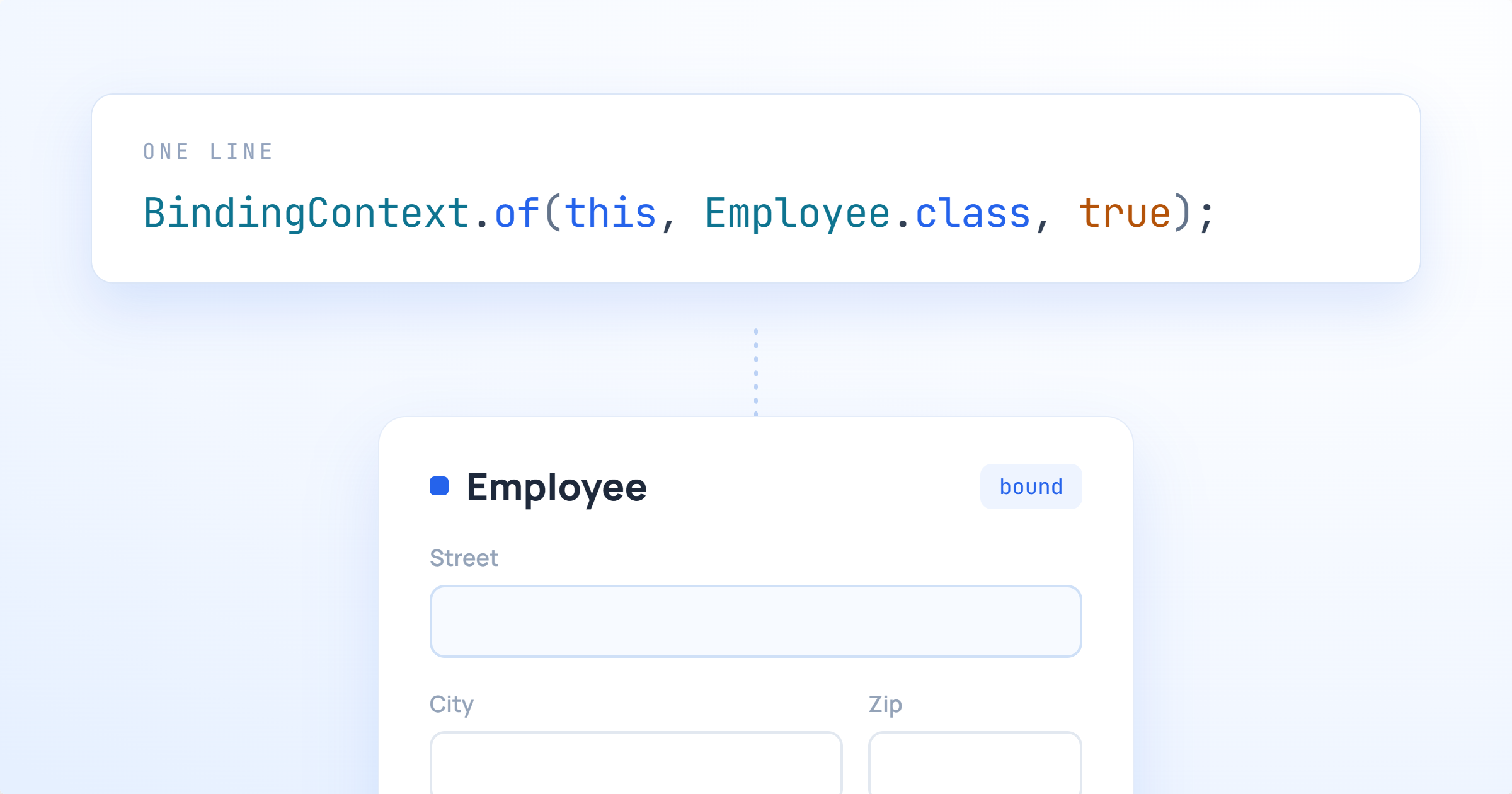
A little while after moving back to the US from working in Germany I was tasked with a colleague of mine to learn some Spring. Bryan and I were in the exact same boat of being totally new to anything more than Java basics, and one of the first tasks we bumped into together was this: take a form on the screen, and wire it up to a Java object that had, of all things, another Java object nested inside of it.

Sounds simple, and it no doubt is to those who are used to Spring and how it works. For us, it was not.

We were told to work with our colleague in Bulgaria to get help, and while he was certainly a Spring expert, the time different meant that we ended up spending days on it. We wrote getter chains, we wrote wrapper DTOs, and we eventually got something working that neither of us really understood. Of course, these days I'd just ask Claude, but he and I hadn't yet been acquainted back then.

If you'd asked me at the time what the "right" way to bind a nested object was, I would have been painfully clueless.

Fast forward to now, and webforJ has this feature baked right in. Past Matthew and past Bryan would have been genuinely thrilled.

Which AI coding tool should a Java team pick in 2026?

· 9 minuuttia
webforJ
Do it all in Java. The full-stack Java framework for business web apps.

cover image

Every few weeks a new AI coding tool claims the top spot, and Java teams end up debating Claude Code against Cursor against Copilot. For day-to-day work on a real Java web app, that debate matters less than it seems.

The best AI coding tools for Java developers are the ones that know the framework you build with. Claude Code, Cursor, Gemini CLI and Codex all write competent Java. The bigger gap is between an assistant that guesses at your framework and one that looks it up. With webforJ, one plugin install gives any of them the real docs, project scaffolding, theme generation, and token validation.

Build internal tools in Java: a framework decision guide

· 8 minuuttia
webforJ
Do it all in Java. The full-stack Java framework for business web apps.

cover image

Someone on the team needs a screen where support can look up an account, fix a record, and see an audit trail. The data is already in your Java services, and the request is small. It still turns into a project once you add a second language, a build pipeline and an API layer just to draw a table.

If you want to build internal tools in Java, pick a framework that lets the backend team write the UI in the same language, in the same project, against the same services. That's what webforJ does, as a full-stack Java framework. A view is a Java class, a table reads from your repository, a form binds to your bean, and route annotations decide who gets in.