~/webforj/blog $ ls --tag=mvc → 4 posts rss

4 posts tagged with "MVC"

Model-View-Controller architecture patterns.

View all tags

Bind a Java bean to form fields automatically in webforJ

· 7 min read

Matthew Hawkins
Software Developer

cover image

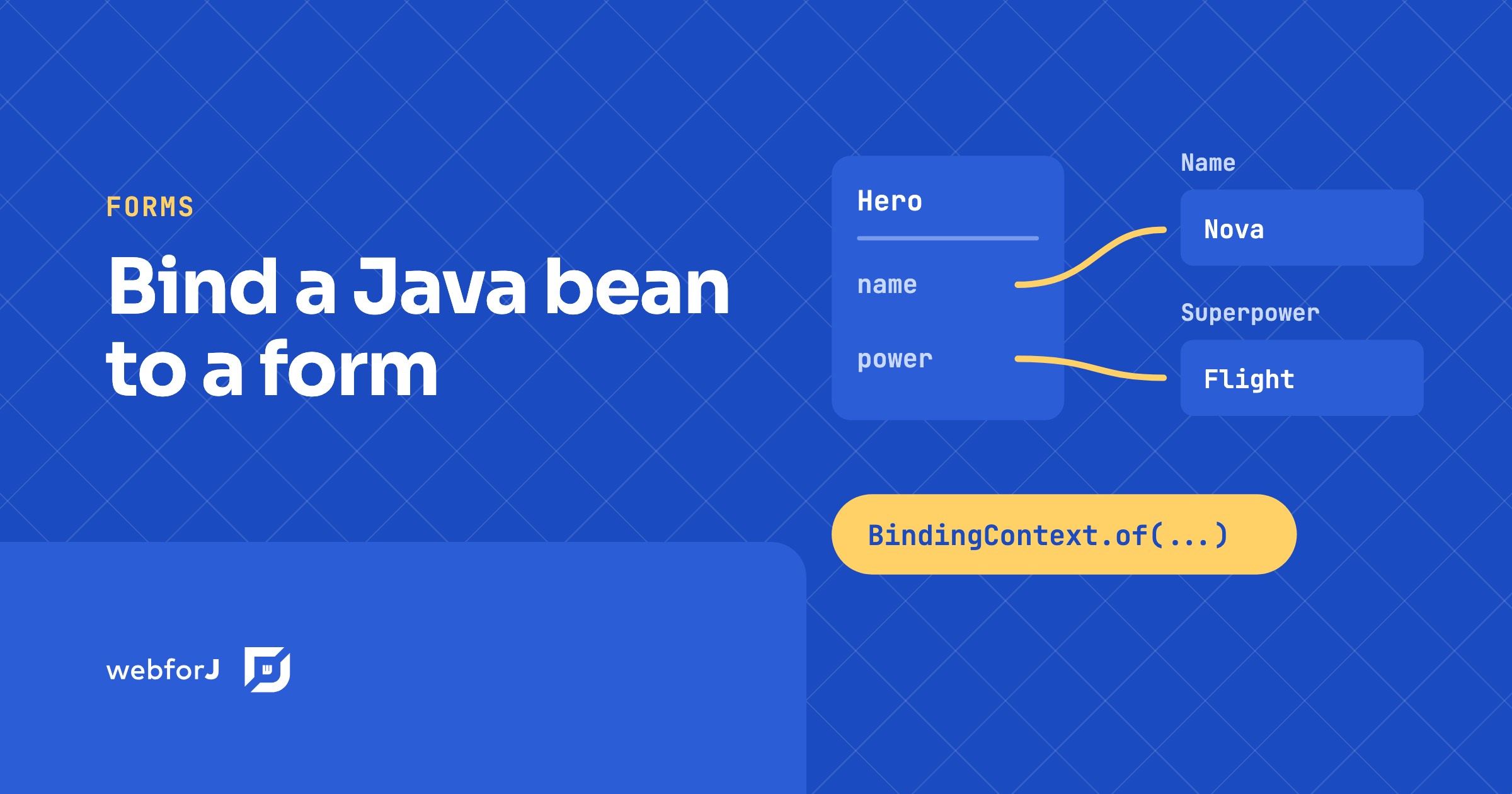
To bind a Java bean to form fields in webforJ, call BindingContext.of with the form, the bean class, and the bean. webforJ matches each field to a bean property by name, so a TextField named name fills the name property without any wiring code. In this tutorial you build a small hero form. You will bind fields automatically, map one field with an annotation, exclude a field that has no matching property, and save the bean only when the form is valid.

Why Teams Keep JSP Alive, and What a Java-Native Path Forward Looks Like

· 11 min read
webforJ
Do it all in Java. The full-stack Java framework for business web apps.

cover

The customers.jsp has been in production since 2011. The team knows every quirk: the pageContext.getAttribute calls that pull in the session-managed customer list, the JSTL loop that renders the rows, the shared header partial included from /WEB-INF/includes/header.jsp. It works. Operations knows how to deploy a WAR. The business rules are encoded in the tag libraries. On Monday, leadership asked for a modernization plan.

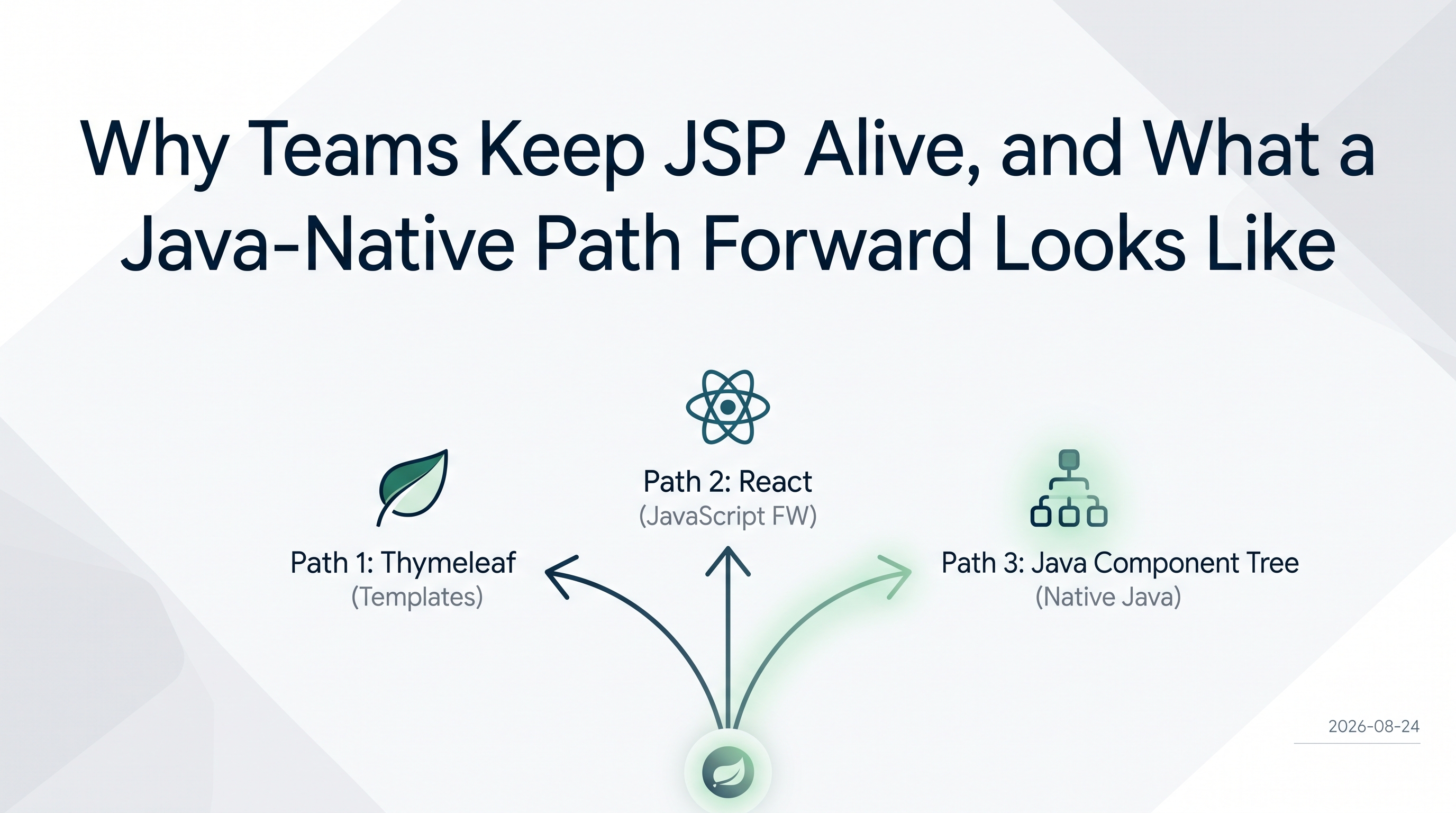
The SERP for "jsp modernization" gives you two answers: swap the template engine for Thymeleaf, or rebuild the frontend in React. Both are legitimate paths. Neither removes the template layer.

This post covers the third option: replace the JSP page with a Java component tree. Views become Java classes. The loop disappears from the source. The taglib becomes a plain Java class. The include becomes a constructor call. This is not a new idea: it is just underrepresented in the search results because most teams that have done it have not written it down.

A Java reactive UI framework without reactive streams

· 8 min read
Matthew Hawkins
Software Developer

cover image

You change a value somewhere in your Java code, and you want the screen to follow without hand-writing refresh calls for every label and every table. That is what most developers mean when they search for a Java reactive UI framework, and it rarely has anything to do with reactive streams.

webforJ, the full-stack Java framework, is a Java reactive UI framework in the sense that matters for screens: the UI reacts to events, to bound data and to repository commits, and background work can push changes to the page. It does this with event listeners and data binding, not with a streams library, and this post shows how those pieces fit together.

Building a Todo App with MVC Pattern in webforJ

· 10 min read
Matthew Hawkins
Software Developer

cover image

Remember learning about Model-View-Controller (MVC) in university? For most, at least from what I hear when speaking to others, they had to actually create an app following this design paradigm, which greatly helps any future use of this pattern in the "real world."

For me, that class was right in the middle of COVID. Our instructor was a nice enough guy, but between the Zoom fatigue and lack of experience (I'm fairly sure it was his first or second term teaching), not only did we not end up actually building anything, but we spent time doing theoretical explorations of the various design patterns out there, with MVC only receiving a few days of review.

All this to say that when I started working with webforJ, I saw it as the perfect opportunity to finally get hands-on with MVC—not just to understand the pattern properly this time, but also to learn how webforJ fits into this paradigm. Building a stereotypical todo app seemed like the ideal way to explore both.